

FIELD TEST · ULTRA COURSE
MANAGING YOUR BATTERY ON THE TRANSVÉSUBIENNE
A full-scale course reconnaissance to understand where energy is used, plan battery changes and tackle the 80 km with a solid strategy.
80 KM
La Colmiane → Nice
+2,850 M
Elevation gain
2 × 725 WH
Tested capacity
1 BATTERY CHANGE
Test strategy
The bike used for the test
Lapierre Overvolt GLP III Elite
The consumption figures shown correspond to this bike, this battery and this rider. They provide a real-world reference, not a guaranteed range.
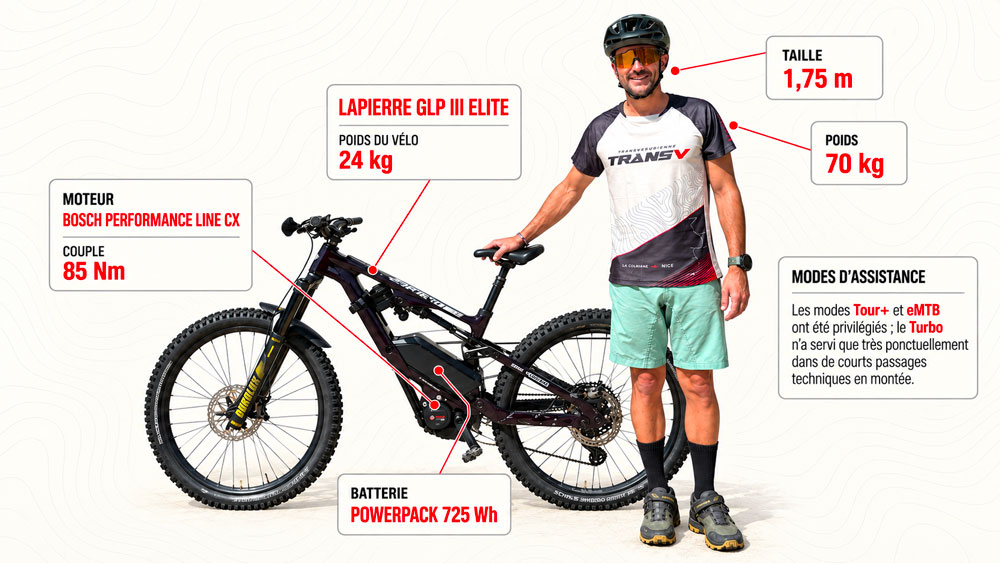
TEST SETUP
Bike: Lapierre GLP III Elite
Bike weight: 24.1 kg
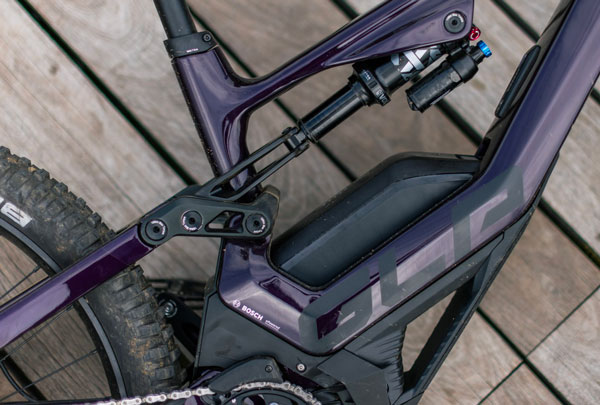
Motor: Bosch Performance Line CX · 85 Nm
Battery: PowerPack 725 Wh
Rider: 1.75 m · 70 kg
TOUR+ eMTB TURBO · VERY RARELY
The strategy used during the test
Two batteries. One change.
The battery was changed at Gineste inférieur, at kilometre 38. Tour+ and eMTB were the main assistance modes; Turbo was used only very occasionally on short, technical climbs.
92 %
BATTERY 1
38 km · +1 520 m
La Colmiane → Gineste inférieur
BATTERY CHANGE
KM 38
Gineste inférieur
84 %
BATTERY 2
42 km · +1 330 m
Gineste inférieur → Nice
16% remaining at the finish
AVAILABLE BATTERY CHANGE POINTS
KM 26
LANTOSQUE
First available battery change point.
KM 38 · TEST CHOICE
GINESTE INFÉRIEUR
Battery changed after using 92%.
KM 52
LEVENS
Last available battery change point.

Course breakdown
Battery consumption, segment by segment
Each figure is the percentage recorded from a 725 Wh battery. Segment readings are rounded and should be used as real-world guidance.
SEGMENT 01
37 %
USED
La Colmiane → Roquebillière
0 → 20 km 20 km E-bike timing starts at km 4
From the start to Col de Varaire at km 4, you are not timed. Around 13 km require pedalling; the final 7 km are almost entirely downhill. Most of the battery consumption therefore occurs during the first major part of this segment.
SEGMENT 02
18 %
USED
Roquebillière → Lantosque
20 → 26 km 6 km Battery change available
A lively section alternating very short climbs, descents and flat terrain. Stay punchy while keeping an eye on your battery consumption.
SEGMENT 03
37 %
USED
Lantosque → Gineste inférieur
26 → 38 km 12 km Battery changed
The first two-thirds are rolling and undulating, mixing climbs, descents, flatter sections and technical terrain. The final third marks the beginning of the climb towards Utelle. Gineste inférieur is the battery change point used during this test.
SEGMENT 04
9 %
USED
Gineste inférieur → Utelle
38 → 39.5 km 1.5 km Very technical climb
An entirely uphill and highly technical section. Part of the race could be decided here: manage your energy and be ready to ride cleanly on the climb.
SEGMENT 05
8 %
USED
Utelle → Pont de Cros
39.5 → 47.5 km 8 km Mainly downhill
A predominantly downhill section with only a few short uphill efforts. Battery consumption remains low.
SEGMENT 06
20 %
USED
Pont de Cros → Levens
47.5 → 52 km 4.5 km Sustained climb
A technical climb where part of the race could be decided. Make sure you keep enough energy for this ascent. Battery use remains continuous.
SEGMENT 07
11 %
USED
Levens → Col de Rosa
52 → 56 km 4 km Starts with a descent
The segment is uphill, technical and physically demanding. Keep enough battery in reserve to tackle it efficiently.
SEGMENT 08
18 %
USED
Col de Rosa → Baisse de Bordinas
56 → 66 km 10 km Rolling terrain
Uphill passages are interspersed with predominantly downhill sections. Maintain a smooth rhythm, avoid energy-sapping accelerations and look after your equipment.
SEGMENT 09
11 %
USED
Baisse de Bordinas → Saint-André
66 → 72 km 6 km Two rideable climbs
This section is on the road. Short climbs account for only a small part of the segment; the rest is downhill.
SEGMENT 10
10 %
USED
Saint-André → Nice
72 → 80 km 8 km Final climb: 5 km
The section between Saint-André and Nice is entirely on roads and cycle paths. It is fully rideable and non-technical. A short climb then leads to the final finish on Castle Hill.
KEY POINT
Battery consumption is not proportional to distance. Short uphill sections — particularly Pont de Cros → Levens — can use more energy than much longer descents.
A REAL-WORLD TEST, NOT A RANGE GUARANTEE
Battery consumption varies according to the weight of the rider and equipment, the bike, motor, battery capacity and condition, assistance mode, fitness level, riding style, tyre pressure, terrain and weather. Test your own equipment before the event and always keep a safety margin.
The segment percentages are rounded readings; the totals of 92% and 84% correspond to the overall battery readings recorded during the course reconnaissance.